Any job that requires working above ground level eventually runs into the same question: boom lift or scissor lift? Both machines get workers safely into the air, but they solve genuinely different access problems, and choosing the wrong one for a specific job means either struggling to reach where you actually need to work or paying for reach and mobility you didn't need in the first place.
This guide covers how these two aerial work platforms differ, which situations favor each one, and how terrain and project type across West Georgia and East Alabama specifically factor into the decision.
What a Scissor Lift Actually Is
A scissor lift raises its platform straight up through a crisscrossing, folding support structure, moving purely vertically without any horizontal reach beyond the platform's footprint. This straightforward up-and-down motion makes scissor lifts stable, with a larger platform than most boom lifts offer, giving workers more room to carry materials and tools while working at height.
That larger platform and straightforward vertical travel make scissor lifts a strong fit for work directly above a stable, relatively flat surface, think interior ceiling work, warehouse racking, or exterior work on a building where the lift can be positioned directly beneath the work area without needing to reach around or over any obstacles.
What a Boom Lift Actually Is
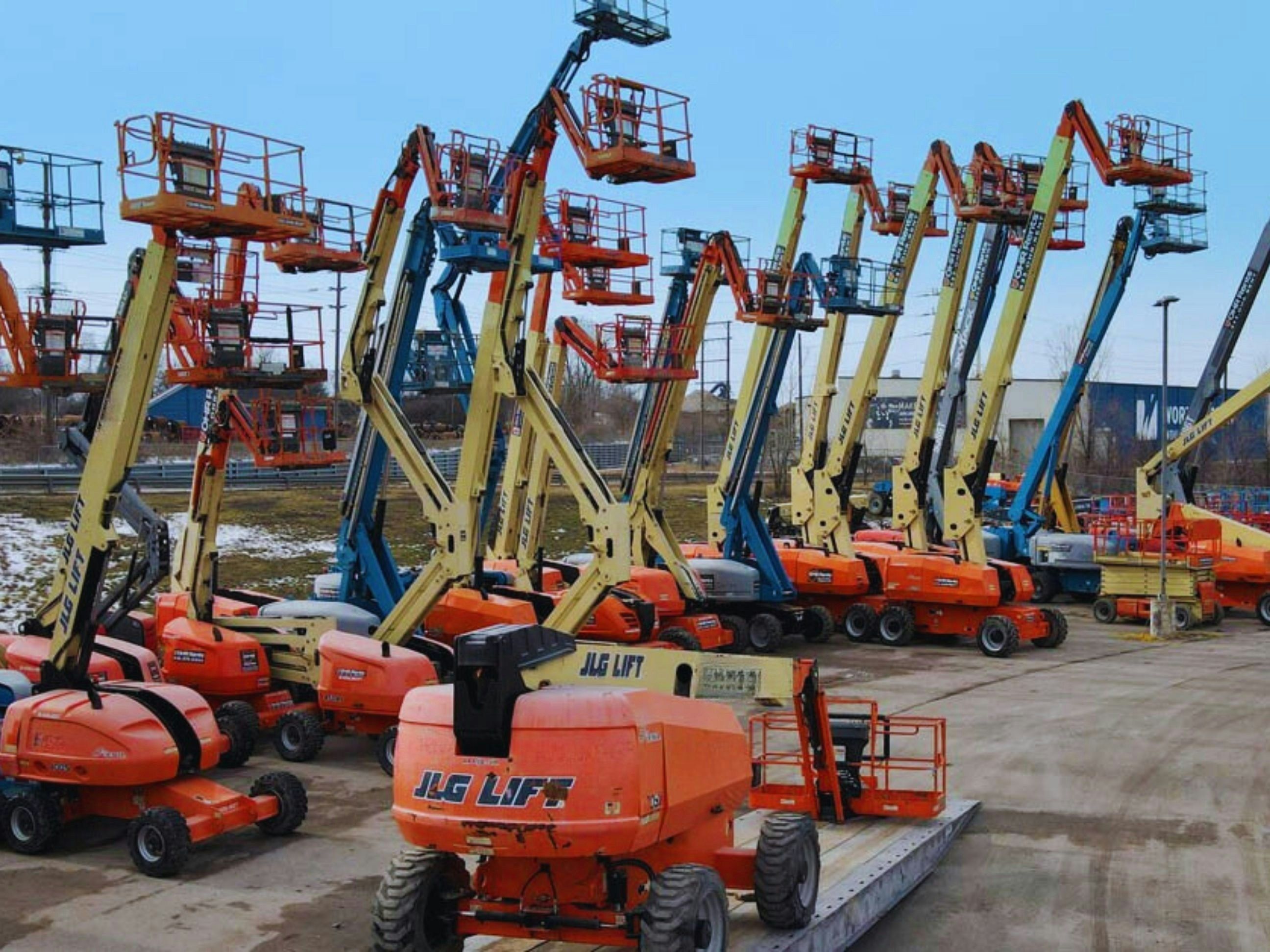
Boom lifts, by contrast, offer both vertical and horizontal reach through either a telescoping or articulating arm, allowing the platform to extend up and out from the base rather than moving straight up alone. This reach capability is what makes boom lifts the right choice when the work area isn't directly accessible from below, over a fence line, above a piece of equipment, across a retention pond, or up and over any other obstacle that a purely vertical scissor lift simply can't navigate around.
Articulating boom lifts add jointed arm sections that let the platform maneuver around obstacles with real flexibility, while telescoping boom lifts extend in a straighter line for maximum reach distance. Both configurations trade some of a scissor lift's platform size and stability for the ability to reach places a straight vertical lift never could.
The Core Decision: Reach Pattern vs. Platform Space
The fundamental tradeoff between these two machine types comes down to what your specific job actually needs. If the work is directly above a stable surface and doesn't require reaching around or over anything, a scissor lift's larger platform and straightforward operation is usually the more practical, often more cost-effective choice. If the work requires reaching over an obstacle, working from an angle, or accessing a spot that isn't directly beneath a stable base position, a boom lift's extended reach is what actually gets the job done.
Trying to force a scissor lift into a job that really calls for a boom lift's reach, or paying for a boom lift's added capability on a job that a scissor lift would have handled perfectly well, both represent avoidable inefficiency that comes down to understanding this core distinction before choosing equipment.
Terrain Considerations Across West Georgia and East Alabama
Ground conditions matter enormously for this decision, and the region's mix of urban, suburban, and rural project sites brings real variation in what terrain a lift needs to handle. Scissor lifts generally perform best on smooth, stable, relatively flat surfaces, indoor floors, paved lots, and prepared exterior grades. Rough terrain boom lifts, built with larger tires and more robust undercarriages, are designed specifically for uneven, unpaved, or sloped ground, common across rural and semi-rural project sites throughout the region where a finished, prepared surface isn't always available.
For projects on sites that haven't been fully graded or paved yet, a rough terrain boom lift is often the only realistic option regardless of whether the work itself would otherwise favor a scissor lift's platform size, simply because the ground conditions rule out a standard scissor lift's more limited mobility.
Common Use Cases for Scissor Lifts
Interior work, warehouse and retail buildout, ceiling and overhead installation, and general maintenance work on stable, prepared surfaces are all strong fits for scissor lifts. Their larger platform accommodates multiple workers or bulkier materials more comfortably than most boom lifts, which matters for tasks requiring more than just a single technician and a handful of tools at height.
Common Use Cases for Boom Lifts
Exterior construction work, building facade access, signage installation, tree and vegetation work, and any task requiring reach over an obstacle or across uneven ground point toward a boom lift. Telecom and utility work, often requiring access to towers or lines positioned well beyond what a straight vertical lift could reach, is another common application where a boom lift's extended, flexible reach is essential rather than optional.
Platform Height and Weight Capacity Matter Too
Beyond the boom-versus-scissor decision itself, sizing the specific lift correctly for your project matters just as much. Platform height needs to comfortably exceed your actual working height, not just barely reach it, since operators need enough clearance to work comfortably rather than straining at the very top of a lift's rated range. Weight capacity needs to account for workers, tools, and any materials being carried up together, not just a single technician's body weight, since overloading a platform is both a safety violation and a real operational hazard.
Getting these details wrong, undersizing height and having to reposition constantly, or underestimating weight capacity and being unable to bring the tools and materials a job actually requires, turns what should be a straightforward equipment decision into a source of daily frustration and lost productivity on site. Working through actual project requirements before selecting a specific lift model avoids this kind of mismatch entirely.
How This Compares to a Telehandler
It's worth distinguishing aerial lifts from telehandlers, since the two get confused occasionally despite serving very different purposes. Our guide on the top 5 telehandler uses for construction sites covers how telehandlers are built primarily for lifting and placing materials, pallets, building supplies, equipment, rather than safely elevating personnel to perform work at height. Boom lifts and scissor lifts are personnel platforms first, designed and rated specifically for workers to operate from at elevation, while a telehandler's forks or attachment are built around material handling rather than a certified work platform for people.
Renting vs. Owning Aerial Equipment
Most contractors and property owners need aerial lift access intermittently rather than constantly, which makes rental a practical fit for this equipment category specifically. Our comparison of heavy equipment rental vs. purchase covers this decision more broadly, and aerial lifts are a strong example of equipment where rental flexibility, matching the right lift type and reach to each specific project, often makes more sense than committing to ownership of a single configuration that won't fit every job's terrain and reach requirements equally well.
Maintenance and Safety Considerations
Aerial lifts carry real safety stakes given that they're supporting workers at height, and mechanical reliability matters as much here as on any other piece of rental equipment, arguably more given the consequences of a failure while a worker is elevated. Our guide on preventative maintenance and heavy equipment downtime covers why proactive maintenance matters across equipment categories, and it's worth confirming that any aerial lift you're renting has been properly inspected and maintained before it's ever put into service on your site.
Matching Equipment to Your Specific Project
Choosing between a boom lift and scissor lift, and selecting the right size and reach within either category, benefits from understanding your project's specific access requirements and site conditions rather than defaulting to whichever machine happens to be most familiar. Our article on how local equipment rental teams solve problems faster speaks to exactly this kind of guidance, matching equipment to the actual job in front of you rather than leaving that decision to guesswork. Our broader guide on choosing the right equipment for your construction project covers this same equipment-matching principle across other categories, and aerial lift selection follows the identical logic: understand the job first, then match the equipment to it.
Final Thoughts
Boom lifts and scissor lifts both solve the basic problem of getting workers safely off the ground, but they solve it in genuinely different ways, and choosing between them comes down to understanding whether your job needs a scissor lift's stable, spacious vertical platform or a boom lift's extended reach over obstacles and uneven ground. Factoring in your specific site's terrain, alongside the nature of the work itself, is what actually determines the right choice, rather than defaulting to whichever lift type happens to come to mind first. Getting this decision right before the job starts saves far more time than trying to make the wrong machine work once it's already on site.